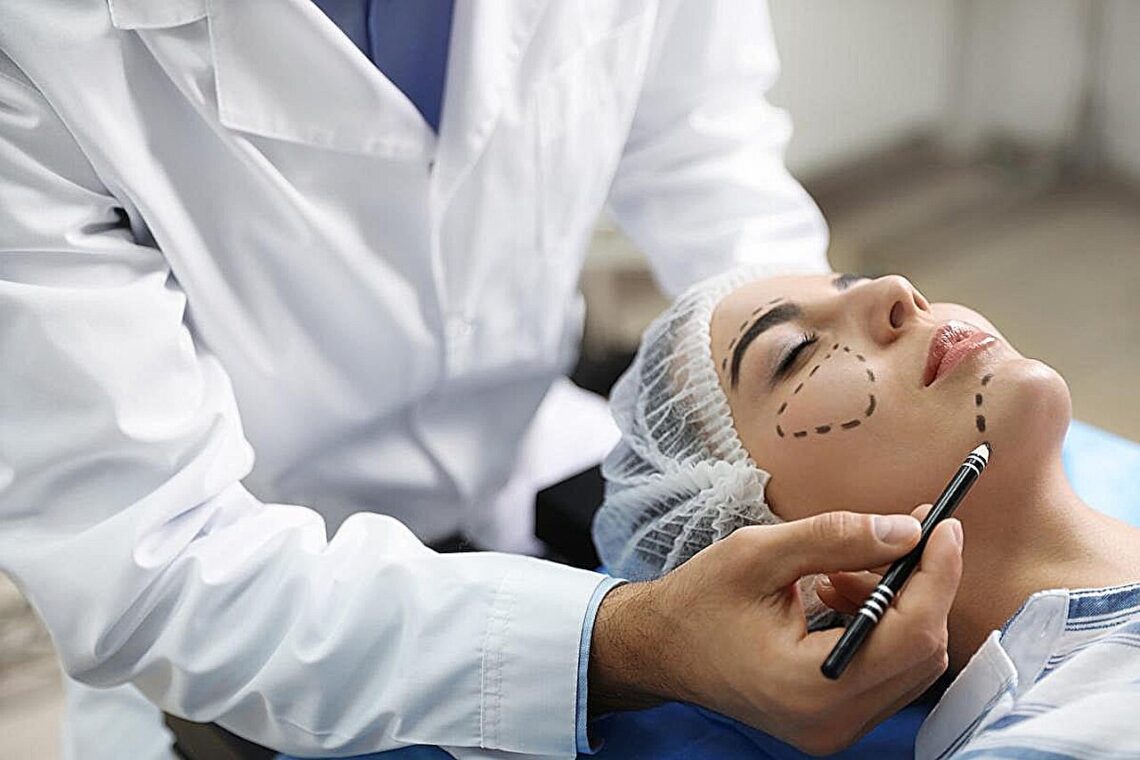
Fixating on one aspect like a “perfect” nose or chin from a certain angle does infinite injustice to the bigger picture. We see it all the time: a beautiful nose from the front that looks totally unnatural in the profile. Or a well-contoured chin that throws the mouth all out of proportion. Features don’t exist in isolation, so chasing perfection one piece at a time can destroy the whole.
What facial harmony actually means in surgical terms
Facial harmony is more than a look, more than a feeling, more than a catchphrase. It’s a guidepost by which aesthetic surgeons navigate a staggeringly complex series of choices. The distance between the eyes should equal the width of the canal of the ear. The tip of the nose should be at a 90-degree angle to the upper lip. The subnasale – the divot between the nose and the upper lip – should line up with the middle of the iris and so on.
Why the golden ratio is a starting point, not a rulebook
The golden ratio is something that has been referred to time and again as a foundational principle of beauty – in nature, art and also the human form. Beauty, however, is a relative term. What could be beautiful for one person may not be as appealing to another.
This golden ratio may indeed be a reality, but still is not a standard that all cosmetic surgeries can or should follow. Beauty is defined by cultural norms, personal attributes, and society. It is in no way a fixed standard.
The rhinoplasty problem: fixing one feature can break the rest
Rhinoplasty is the clearest example of why isolated perfection fails. It’s also one of the most requested procedures in facial plastic surgery, with more than 350,000 rhinoplasties performed annually in the United States alone in recent years (ASPS). That volume tells you something: a lot of patients walk in focused entirely on their nose, without factoring in how it sits relative to the rest of their face.
Here’s the trap. If a patient has a recessive chin and a surgeon reduces the nose aggressively to make it look “smaller” or “more refined,” the profile can actually look worse afterward. Without adequate chin projection to balance it, an overly reduced nose can make the lower face look weaker and the whole profile look unfinished. This is exactly why chin augmentation, or genioplasty, is frequently discussed alongside rhinoplasty consultations. The nose and chin are evaluated as a pair, not as separate projects.
A surgeon focused on harmony will often recommend a smaller, more conservative change to the nose combined with modest chin augmentation, rather than a dramatic nose reduction on its own. The combined result reads as more balanced, even though neither individual change is as dramatic as the patient may have initially wanted.
Perfection mindset versus harmony mindset
The perfection approach can be successful when the stars align, when a person is exceptionally fortunate enough to have all or nearly all of their features line up perfectly with industry standards, and when they’re even more fortunate to land a surgeon who intuitively knows where the margins are and doesn’t push too far. This happens more than you think – the vast majority of cosmetic surgery results you see on the street (as opposed to in entertainment media) fall into this camp. They look organic, they look “normal”, and many of them required a series of relatively minor tweaks to achieve that state.
The cultural angle: why Korean aesthetic practice centers on balance
South Korea’s aesthetic medicine wasn’t ever really about transformation in the way we understand it elsewhere. Dominated by a hard-to-quantify ideal of “small but better,” aesthetic medicine in Seoul and across the country obsesses over specific tweaks; subtle shifts that are all the more painstaking in their perfection for being almost impossible to articulate.
This is part of why so many patients research Korean face surgery specifically – the surgical culture there tends to prioritize natural-looking, proportional outcomes over dramatic, single-feature alteration. It was reinforced by Seoul fashion itself, where all the most tempting plastic surgery adverts promised the fiercest, most otherworldly results.
Non-surgical treatments as a low-risk test run
Not every change that benefits the face has to be irreversible. Injectables and temporary measures, often seen as “gateway” procedures to surgery, can instead be used to preview the effects of a volume or projection change in real life on the patient’s unique anatomy. If proportion and balance improve, the change isn’t wasted or “just” temporary; that was information you needed. If not, take the time to adjust the plan.
We use these techniques in the office every day, every time we evaluate a patient’s face using mirrors and photos of them when they were younger. It’s the same concept: if a few units of Botox create the desired eyebrow lift of a Botox Browlift, then that’s a much more appealing procedure to offer than a patient simply hoping they will get a little brow lift from their Botox treatment.
The over-operated face is a warning sign, not an inevitability
If your goal is to have procedures that blend together seamlessly and look like relaxed, beautiful versions of you, then, aside from choosing an excellent surgeon with a focus on the natural look, one of the most impactful decisions you can make is to have all your planned work done at once. Leave recovery only in your past and not in your future.
This isn’t about trying to “get your money’s worth” in the OR. There should be a reasonable limit to the number of changes you make in one procedure – more than five or six, and even a balanced recovery can be a challenge, meaning that the last things you have done aren’t going to come out as good as they would have if you’d faced them fresh.
This is more about thinking, year over year, about your face as a unified whole. Every change you enact ripples out along lines of gravity and tension, altering the way every bit of you interacts with and complements every other bit. For results that truly are greater than the sum of their parts, you need to think of your face this way every time you step into the office. And no one who builds a sustainable career on producing good-looking faces will do it any other way.
What a good consultation actually looks like
Planning of harmony is more important than discovery of it. This all takes place in the consultation, and it should feel different from a simple request-and-confirm exchange.
Many modern practices rely on 3D imaging and digital simulation in their consults. Rather than sending a patient home with a cubic centimeter measurement they’d likely forget and a mirror’s reflection they can’t really gauge, this tool lets the patient see for themselves how a tweak to one aspect would look translated over their anatomy and skin. Not an attractive or unflattering preview – a preview.
Will this requested tweak look naturally proportional? Will it necessitate an addition or counterbalance somewhere nearby to make sense visually? Often, the straight-on profile under ideal studio lighting that represents most public consultation photos is all the information a surgeon or injector has ever seen. But faces move, and they’re different in motion. They’re also transformed in structure by moving shadows. A subject shot outdoors at high noon going into the wind is a fundamentally different cry for correction than the same face indoors while a fluffy cloud rolls across the sun. And that’s to say nothing of the emotional expression across the course of five minutes. A creative director evaluates the whole spread. A surgeon who only looks at one frame stalls with incomplete information.
What patients should actually be listening for
The ideal indicator that a procedure has been effective is not that someone compliments the specific facial feature that was altered. The best indicator is when someone familiar with you mentions, for example, that you look more relaxed, healthier, or “like yourself, just rejuvenated” – because they shouldn’t be able to put their finger on what’s changed.
In those cases, the adjustment blended in perfectly with the natural elements of your face, such that people don’t realize that it was changed features that produced a positive shift in the total aesthetic. This is the essence of a harmony-based process, and it’s a far superior test of a surgery than whether a nose or chin conforms to a textbook ratio of dimensions.
Facial plastic surgery will produce optimal results in cases where it is seen as an overall system rather than a piecemeal, feature-by-feature series of surgeries. The nose, chin, eyes, and cheeks all play a role in how each of these areas is perceived in relation to the rest, so altering any one of them causes a shift in how the others will be seen. A patient who understands this before even walking in the door will be well-equipped to ask the right sorts of questions – and recognize the right sort of surgeon.